Friday, October 8, 2010

Chicken Weekend Approaches

I've been having an internal debate on how to start this post. I considered including a "Please Note" (but definitely not a "warning") that the post would include blunt talk about processing chickens and some readers might want to skip it. But I really think that all eaters (all consumers, really) should have an awareness of where their products come from. So, there is no disclaimer - I'm not giving you an easy excuse to ignore this post. If choose not to read any further, it's got to be your decision.

Perhaps a more appropriate warning would be that this post is a bit preachy. While it strongly conveys my views, I don't want it mistaken for a lecture or condemnation of anyone who disagrees with me. As I hope you understand after reading the post - it takes pretty strong feelings about food and the environment to raise your own meat. I just want to explain why we've decided to follow through with a seemingly radical food choice.

This weekend is Chicken Weekend. I'm not going to lie - I've been dreading it for months. We've got 20 chickens (mostly Dark Cornish) to butcher, which is twice as many as we did on our last Chicken Day.


It is a crappy, crappy day, and knowing that it will be twice as long as last year is not adding to my enthusiasm. But at the end of the weekend, we'll have one less flock to feed and worry about becoming hawk food (we've caught a Cooper’s Hawk feasting on our chickens three times in the last month).

More importantly, and the real reason we do this is the satisfaction of living our convictions of supporting sustainable, natural food and relieving some of the burden of outsourcing crappy jobs to other people.

These are the two biggies of why we endure Chicken Day. And for me, it’s "barely endure." Last year, I was on the verge of tears. My job is plucking, which compared to Bill's work is easy. But it's still hard work combined with the emotional toil of partaking in the direct killing of an animal…multiple animals. I've made a personal commitment to be present for the killing of all our livestock. Though I don't actually *do* anything, I don't want Bill to do it alone, and I think it's important to fully appreciate the sacrifice.


There was recently an article in the NY Times by Michael Pollan. He participated in a 36-Hour meal based heavily on a single goat, a cob oven, and a good community.

Ten days ago, Mike and I drove to the ranch to choose our animal and watch an itinerant butcher slaughter and dress it; Mike says the experience made him want to honor our goat by wasting as little of it as possible.
I don't know if it's possible to overemphasize that point. When you are involved in butchering, waste becomes intolerable.

As much as I am still dreading it, my resolve for Chicken Weekend has been bolstered by that article and blog posts, which were kind enough to have the excellent timing of being published this week.

One is from Sharon Astyk who farms and writes in upstate NY. Her post "On Sentiment...And Against Sentimentality" is about many aspects of farming and the attitude needed to be successful. She believes there is a difference between sentiment - "the logical emotions of love and attachment that emerge from knowing something well" - and sentimentality - "cheap emotion, the substitution of a weak thing for something deeper.”

Sentiment, Astyk argues, is essential for good farmers. You need to pay very close attention to your animals in order to care for them well. This attention naturally leads to feelings of love, appreciation and attachment. I understand this completely. I am jarred by the heartbreak that accompanies the inevitable loss of an animal to a predator or illness. It sucks. And not just for the loss of time, money and energy that went into growing something that is now gone. It is a feeling of failure (no matter how unjustified) in not protecting an animal who depends on me - an animal I care for physically and emotionally.

Sentiment - love, anger, attachment, affection - real emotions - these derive from knowledge, and they can't be faked.
Sentimentality, on the other hand, is the “cheap” emotion based on…well, nothing really. I think of it as manufactured – the stuff of Hallmark commercials and reality TV. This, here, is the bit of Astyk’s post that will be helping me get through Chicken Weekend:

I do want to stand up for sentiment in agriculture because I would argue that our industrial society discourages real sentiment, the emotion that emerges from knowing things, and exchanges it for sentimentality. This is an exchange that runs deeply to our detriment, in part because it enables us not to know things.

Sentimentality creates the CAFO (concentrated animal feeding operation) farm - the sentimentality that says we are too weak to bear the pain of knowing animals and watching them die. This is what turns our food into styrofoam packages and allows CAFO agriculture, where animals are carefully hidden from our view, and the relationship of our purchases carefully concealed.
In this instance, giving in to sentimentality and not wanting to know things (or read this blog post) creates the real evil. How evil?

something on the order of 98% of our meat in America comes from factory farms that raise thousands upon thousands of animals at a time. To satisfy our ever-increasing demand for cheap meat, the places where animals are raised for slaughter have changed so radically that it’s not even really fair to call them farms. (The Unappetizing Realities of Factory-Farmed Meat)

Since 1935, consolidation and industrialization have seen the number of U.S. farms decline from 6.8 million to fewer than 2 million — with the average farmer now feeding 129 Americans, compared with 19 people in 1940.

In CAFOs, large numbers of animals — 1,000 or more in the case of cattle and tens of thousands for chicken and pigs — are kept in close, concentrated conditions and fattened up for slaughter as fast as possible, contributing to efficiencies of scale and thus lower prices. … To stay alive and grow in such conditions, farm animals need pharmaceutical help, which can have further damaging consequences for humans. (Time)
You know these places. They give you salmonella. They are the target of news reports and documentaries. They are really gross. Horrible for the animals and the people that work there. Horrible for the farmers. Great for the big company and the bottom line.

According to the USDA, Americans spend less than 10% of their incomes on food, down from 18% in 1966. (Time)
This weekend, as much as I won't like the work, I am satisfied knowing that I am not supporting a system with which I disagree and believe is unduly harmful to the environment, the "farm" animals, the workers, and ultimately the people who eat the product.

Wednesday, September 22, 2010

Mexican Midgets

Horrible name.


Ridiculously yummy tomato.


Wednesday, August 18, 2010

Today, I ate...

garden tomatoes with local goat cheese:


...vanilla ice cream with bourbon peaches (both homemade, natch)


...and meat on a stick.


At least the dough was homemade...

Sunday, August 15, 2010

Peach seconds


This is the second 1/2 bushel of peaches we've purchased this summer. They are seconds, which means they look ugly, but are half price - perfect for jams.

Some of the bushels were pretty gross - moldy peaches or lots of fruit flies. But this one was good. It takes a little longer to inspect seconds, but it's worth the time. In this 1/2 bushel there were only 4 peaches that were questionable for human consumption and they went to the chickens. These don't look too bad after being blanched, eh?

They became jam. All of them! A few recipes below.

This is my summer jam set up. Far too hot to cook in the brick house, so we have a cast iron propane stove with three burners.


I try to keep the amount of exposed fruit and sugar low to keep the bugs down. Typically I do all the combining of ingredients in the kitchen and just bring the pot outside. That way fruit-covered utensils and sugar coated measuring cups stay inside, near the sink.

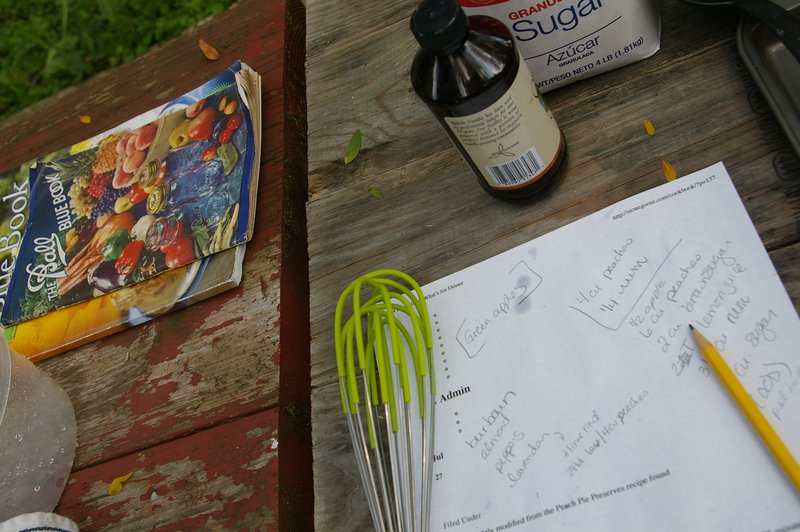
My Ball Blue Books (the blue one is from the 40s - I love it!) and a piece of paper to write down recipes as I go. This year I've been experimenting more, but it's helpful to have info on fruit to sugar ratios from the good folks at Ball.


The far blue pot is sterilizing my jars. The close pot is boiling some jam. See the steam! The poor middle burner never gets used.


Important utensils: wooden spoon for constant siring and a skimmer on the spoon rest (which gets washed about 80 times a day during jam season), and my teaspoon on a cup contraption. I scoop a little jam on the spoon and let it sit on the cup to cool a little to assist in finding the gelling point. This is more for the coarse testing - finer testing is done with a freezer plate - but the spoon lets me know when I'm close.

And a cookie sheet (which also gets washed 80 times a day) to help tote everything from the sink to the picnic table.


24 jars of jam! From farthest to closest:

  1. plain jam with pectin
  2. peach rum jam
  3. jalapeno peach jam (below)
  4. peach honey lavender jam (same recipe as the strawberry honey lavender)
  5. vanilla bourbon peach syrup (below)


Many of these are only soft set, which means they are a bit runny. Because the flavors aren't really what we're looking for on toast, I've left them thinner for ice cream, pancakes and yogurt.

Yum.

Jalapeno Peach Jam
4 cups peaches
3 cups sugar
1.5 teaspoons jalapeno pepper flakes
juice of 1/2 lemon

Put it all in the pot and boil until gelling point (or a little thinner). Process 10 minutes in boiling water bath.

We're thinking this will go great with goat cheese or brie. Or maybe to accompany smoked chicken/turkey.

Vanilla Bourbon Peach Syrup
4 cups peaches
3 cups sugar
juice of 1/2 lemon
1.5 teaspoon vanilla
1/2 cup bourbon

Toss everything but the bourbon in the pot and boil close to gelling point. When you've only got a few minutes left of boiling, add the bourbon. It's going to thin out a lot - boil until it thickens to your liking. Process 10 minutes in boiling water bath.

If you add the bourbon early, a lot of the flavor cooks out. Adding it at the end preserves the flavor, but makes the jam thinner. Because this isn't really a flavor I crave on toast, I'm cool with that. Most of this is destined for ice cream or maybe shortcake (if I don't eat it all with a spoon, first.)

Thursday, August 12, 2010

Fast Food Fix

From BBC News
Give out statins with junk food

Fast food outlets should consider handing out cholesterol-lowering drugs to combat the effects of fatty food, say UK researchers.

According to the article, we could save so many lives for the cost of a packet of ketchup. And no one has to change their eating habits!! Brilliant solution, yeah?

Sunday, July 11, 2010

Berries Blue

We got 10 pounds of Indiana blueberries last weekend.

Ten.

Pounds.

Bill made some dutch oven blueberry cobbler over a fire (pictured with homemade vanilla ice cream):


I made jam, natch. One is blueberry lime from the Ball Blue Book. It is my first pectin jam of the season, and the first jam to set. I still need a bit of practice on finding the gelling point. Up till now, I've made a lot of really yummy syrup that will slide right off of toast. The other is blueberry peach (recipe below). It also hit the gelling point. I don't know if that's because blueberries and/or peaches are naturally high in pectin and therefore better at setting, or if I've learned patience.


Can you tell which is lime and which is peach? No? Me either. Which is why we always label jams.


I also made blueberry pie ice cream. It's vanilla ice cream with graham crackers layered with blueberry sauce. Yum. I'd make this again, but I would modify the blueberry sauce a bit to cook more water out of the berries. After only 7-10 minutes of boiling, most of the berries are still intact and freeze into little berry ice cubes. I think a longer cook, or even using some jam, would mitigate this.


Also, I might have to make my own graham crackers. We have a "no transfats in the house" rule, and it turns out nearly all graham crackers are made with partially hydrogenated oils. Except the organic ones. Which taste like cardboard.

After all this, plus freezing a bunch of berries and tons of munching, we've still got some left in the fridge.

10 pounds is a lot of blueberries....


Blueberry Peach Jam

3 peaches, skinned and cut into small pieces (~2 cups)
3 cups blueberries
3.25 cups of sugar
squeeze of lemon juice

Combine into pot, boil to jelling point. Fill hot jars, process 15 minutes in boiling water bath.

Saturday, June 19, 2010

Variations on Strawberry Jam

Over the past two weeks we purchased three flats of local strawberries at the Farmers Market. That's 24 quarts or 6 gallons! We ate some, made some strawberry bread, froze a bunch and made some ice cream.

But, of course, I had to make jam too!


The first flat of strawberries was a bit under-ripe. It was the first week of the farmers market and I think the strawberries were rushed. They weren't real flavorful on their own, so I chose jam recipes that included a lot of other flavor: Strawberry Lemon Marmalade (with thyme) and Strawberry Balsamic Black Pepper Jam (recipes below).


The following week the strawberries were much better and became jam with a greater emphasis on fruit and less on accouterments. In addition to plain ole strawberry, we made some Strawberry Honey Lavender and Plum-Kissed Strawberry (recipes also below).


Strawberry Lemon Marmalade (with Thyme) - adapted from Ball Blue Book.
1/4 cup lemon peel
4 cups strawberries
2 lemons - juice and pulp
5 scant cups of sugar
3 sprigs of thyme

Boil the lemon peel for 5 minutes and drain.
Crush strawberries
Add everything to a pot and boil to jelling point
Fill sterilized jars and boil in hot water bath for 10 minutes

Strawberry Balsamic Black Pepper - adapted from Canadian Living
4 cups strawberries
approx 1.5 tablespoons balsamic vinegar
1/4 teaspoon black pepper
3 cups sugar

Crush strawberries
Add everything to a pot and boil to jelling point
Fill sterilized jars and boil in hot water bath for 10 minutes

Strawberry Honey Lavender - adapted from here
4 overflowing cups of strawberries
1.5 cups of honey
1.25 cups sugar
1.5 tsp dried lavender

Crush strawberries
Add everything to a pot and boil to jelling point
Fill sterilized jars and boil in hot water bath for 10 minutes

Plum-Kissed Strawberry Jam
4 plums (canned last fall)
2 cups strawberries
1.5 cups sugar

Crush strawberries and plums
Add everything to a pot and boil to jelling point
Fill sterilized jars and boil in hot water bath for 10 minutes

Plain Old Strawberry - from 1944 Ball Blue Book
Measure all leftover strawberries. Add 3/4 as much sugar as strawberries. Add everything to a pot and boil to jelling point. Fill sterilized jars and boil in hot water bath for 10 minutes